Industry
React Native vs. Flutter vs. Native: Choosing Your Mobile Stack in 2026
A practical comparison of the three real options for building a mobile app in 2026 — and how to pick without guessing.
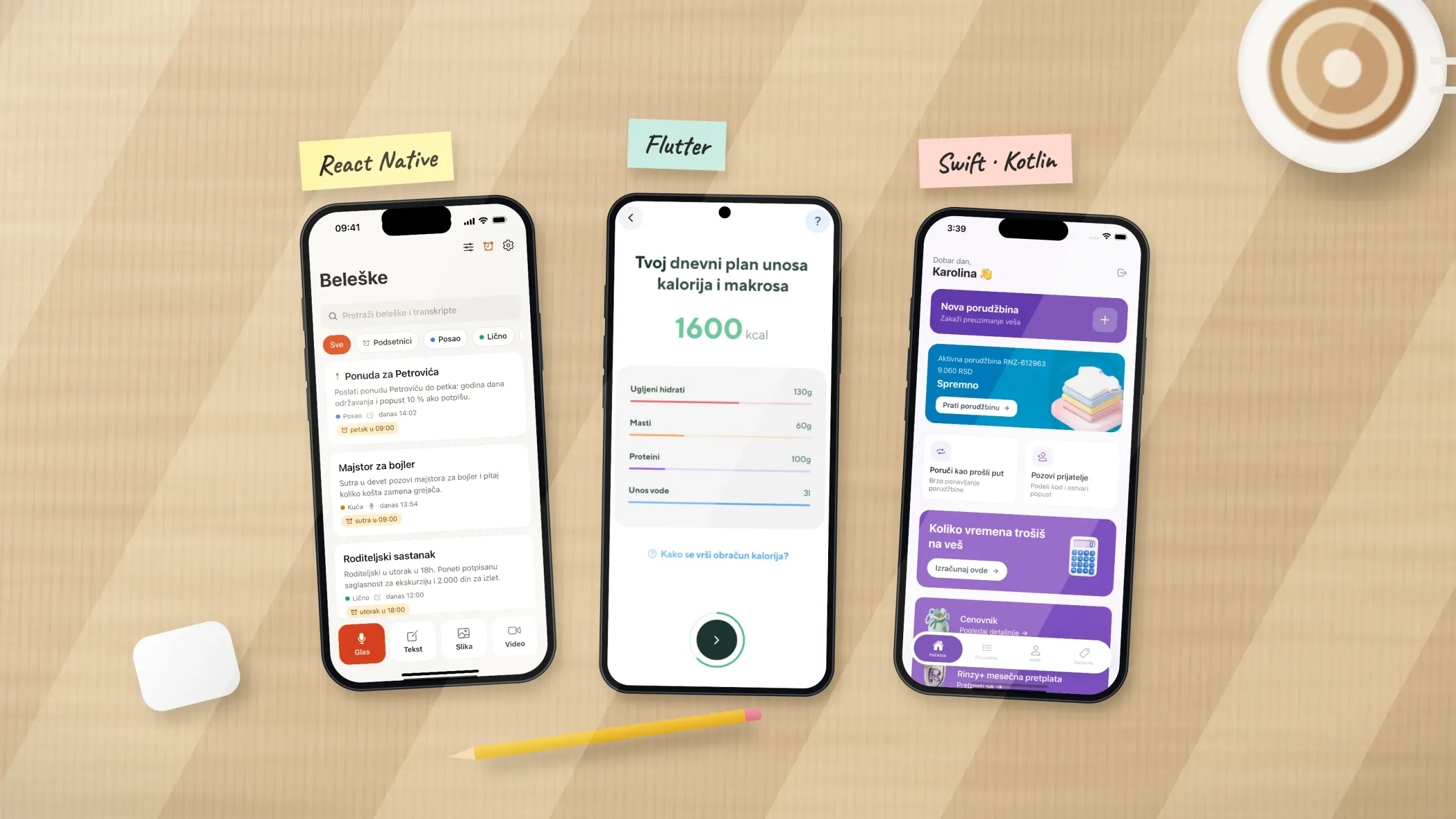
Most founders default to native because it "sounds like what real apps are built with." That instinct costs time and money more often than it saves either.
The three real options
Cross-platform frameworks — React Native and Flutter — share one codebase across iOS and Android. Native (Swift for iOS, Kotlin for Android) means building the app twice, with two codebases to maintain forever after.
When cross-platform is the right call
- You’re validating demand and need to ship on both platforms with one team, fast
- The app is mostly UI and API calls — booking, e-commerce, on-demand, dashboards
- You want feature parity between iOS and Android without building everything twice
When native still wins
Heavy device integration — background location tracking, custom camera pipelines, low-level hardware access like NFC — sometimes needs the control only native gives you. So do performance-critical apps like games or AR.
React Native vs. Flutter
React Native shares real code and knowledge with a web team already working in React or Next.js. Flutter renders its own UI layer, which makes pixel-perfect consistency across OS versions easier, but the regional talent pool is smaller.
For Rinzy’s customer and driver apps, we chose React Native specifically for the NFC library ecosystem and so the mobile and web teams could share components and knowledge. The right stack is the one that matches what you’re actually building — not the one with the loudest fans.
Have a similar idea?